Weight Loss & GLP-1s: Is It Covered by the ACA, Medicare, and What Are Your Other Options?
GLP-1 medications like Semaglutide and Tirzepatide (Ozempic, Wegovy, Mounjaro, Zepbound) are transforming metabolic health — but insurance coverage is a maze. Here is the honest breakdown of how the Affordable Care Act, Medicare Part D, and employer plans actually cover them, why weight-loss-only claims get denied, how to navigate prior authorization, and how the $199/month GLP-1 telehealth program at glp.enrollfirst.com offers a reliable alternative.
John Dennis, Theology MA, MBA, Biology BA — AliveInsure.com
Health, Medicare & Life Insurance Broker

If you've turned on the news, talked to a coworker, or visited your doctor recently, you've heard about GLP-1 receptor agonists — medications like Semaglutide (Ozempic, Wegovy) and Tirzepatide (Mounjaro, Zepbound). Originally developed to treat Type 2 diabetes, these medications have become one of the most effective tools for chronic weight management, cardiovascular risk reduction, and metabolic health. But the single biggest question patients bring to my desk every week is simple: 'Will my health insurance actually pay for it?' The short answer is: sometimes, but only under very specific conditions, and almost never the way most people expect. Let's break down how the Affordable Care Act (ACA), Medicare, and private options really work — and what you can do if insurance says no.
1. How Affordable Care Act (ACA / Obamacare) plans handle GLP-1s. Under the ACA, every comprehensive plan must cover 10 Essential Health Benefit categories, including prescription drugs and preventive wellness visits. But federal law gives each state the flexibility to select its own benchmark plan, which determines which specific prescription drugs are covered on the formulary. Here is the reality in 2026: if your doctor prescribes a GLP-1 specifically for Type 2 diabetes (such as Ozempic or Mounjaro), almost all ACA marketplace plans cover it — though it almost always requires Prior Authorization (PA) and may require 'step therapy' (trying Metformin first). However, if your doctor prescribes the exact same active ingredient branded specifically for weight loss / chronic obesity management (such as Wegovy or Zepbound), the overwhelming majority of ACA marketplace plans explicitly exclude weight-loss drugs from their formularies. A few states have moved to require coverage under specific BMI thresholds (usually BMI ≥ 30, or BMI ≥ 27 with a comorbidity like hypertension or high cholesterol), but for most marketplace consumers, an anti-obesity prescription receives an automatic denial unless diabetes is on the chart.
2. The Medicare rule: Why Medicare Part D generally cannot cover weight-loss drugs by law. This surprises almost everyone turning 65. When Congress created Medicare Part D in the Medicare Modernization Act of 2003, it included a statutory exclusion that explicitly bans Medicare from paying for 'agents when used for anorexia, weight loss, or weight gain.' Because that ban is written into federal statute, no Medicare Advantage plan and no standalone Part D prescription plan can simply decide to cover Wegovy or Zepbound purely for weight loss, no matter how much your doctor recommends it.
The Medicare exception you need to know about. There is a major crack in that door. If you are diagnosed with Type 2 diabetes, Medicare Part D and Medicare Advantage plans CAN and DO cover GLP-1s (Ozempic, Mounjaro, Trulicity, Victoza) on their formularies, subject to the plan's copay tier and prior authorization. Even bigger: CMS issued guidance allowing Medicare Part D plans to cover Wegovy IF it is prescribed to reduce the risk of major adverse cardiovascular events (such as cardiovascular death, non-fatal myocardial infarction, or non-fatal stroke) in adults with established cardiovascular disease AND obesity or overweight. In other words, if your medical record documents diagnosed cardiovascular disease alongside elevated BMI, your broker and doctor can submit a Prior Authorization under that secondary FDA-approved indication. But if your goal is solely weight management, Medicare will not pay. To be crystal clear: if your doctor prescribes Wegovy only for weight loss, it will be denied under Part D and you would be responsible for the full retail price (often $950–$1,350/month).
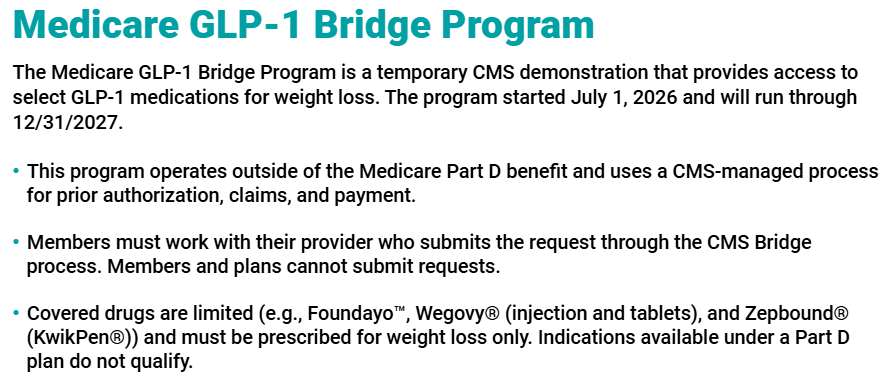
5. The Medicare GLP-1 Bridge program — a new $50/month option (July 1, 2026 – December 31, 2027). The Medicare GLP-1 Bridge Program is a temporary CMS demonstration that provides access to select GLP-1 medications for weight loss. The program started July 1, 2026 and will run through 12/31/2027. Key details you must know: (1) It operates completely outside of the Medicare Part D benefit and uses a dedicated CMS-managed process for prior authorization, claims, and payment. (2) Members must work with their healthcare provider, who must submit the request through the CMS Bridge process — members and insurance plans cannot submit requests directly. (3) Covered drugs are strictly limited (e.g., Foundayo™, Wegovy® in both injection and tablets, and Zepbound® KwikPen®) and MUST be prescribed for weight loss only. Put plainly, beneficiaries are NOT eligible for the Bridge if they have a diagnosis that is already covered under a Part D plan (such as Type 2 diabetes or documented cardiovascular risk reduction), or if they are already receiving a GLP-1 medication through their Part D plan. The copay is a flat $50 per month, which does not count toward your Part D deductible or out-of-pocket maximum. For the official details, visit https://www.medicare.gov/coverage/weight-loss-drugs and https://www.cms.gov/medicare/coverage/prescription-drug-coverage/medicare-glp-1-bridge. I can check your eligibility and help you and your doctor navigate the CMS Bridge submission.
6. Does the Low Income Subsidy (LIS / Extra Help) reduce the cost of a GLP-1? Yes — and this is worth knowing. The Low Income Subsidy, also called Extra Help, is a Medicare program that lowers your Part D premiums, deductibles, and copays if you have limited income and resources. Here is the important split: if your GLP-1 is prescribed for Type 2 diabetes or cardiovascular risk reduction (the covered indications), it is filled through your Part D plan like any other formulary drug — so if you qualify for Extra Help, your copay drops significantly (to about $4.50 or $11.50 per fill in 2026, or even $0 for full-subsidy beneficiaries), instead of the standard brand-name tier. However, the Medicare GLP-1 Bridge program is different. CMS has stated explicitly that there is NO low-income subsidy (LIS) provided for the Bridge, and the $50 copay stays the same for everyone regardless of your Extra Help status. So Extra Help helps you on the Part D-covered path (diabetes / cardiovascular), but it does not reduce the Bridge's flat $50. The practical takeaway: if you already receive Extra Help and you have Type 2 diabetes or documented cardiovascular disease, let's pursue the Part D route first — your out-of-pocket could be far lower than $50. If your only qualifying path is the Bridge, the $50 is fixed regardless. Want to check if you qualify for Extra Help? Apply through the Social Security Administration at https://www.ssa.gov/medicare/extra-help or call 1-800-772-1213. I can also help you confirm which route gives you the lowest cost.
3. The Prior Authorization hurdle: What doctors must submit. Even when a plan covers GLP-1s, the insurance company will not pay the claim at the pharmacy counter without Prior Authorization. Your doctor must submit detailed medical records demonstrating: (1) documented A1C lab results confirming Type 2 diabetes (usually A1C ≥ 6.5%), (2) chart notes proving you have tried and failed first-line therapies (such as Metformin, sulfonylureas, or lifestyle intervention) or have a documented medical contraindication to them, and (3) regular clinical follow-up showing measurable progress. If any piece of that paper trail is missing, the claim is rejected — and the retail cash price at the pharmacy counter typically runs between $950 and $1,350 per month.
4. What are your other options if insurance denies coverage? If you don't have Type 2 diabetes or diagnosed cardiovascular disease, or if your ACA/Medicare plan excludes anti-obesity medications, you are not out of options. Here are the three most common and practical alternatives patients use today:
Option A: Manufacturer Savings Cards (for commercially insured patients). Eli Lilly (Zepbound, Mounjaro) and Novo Nordisk (Wegovy, Ozempic) offer co-pay savings cards that can lower the out-of-pocket cost for patients with private commercial insurance. But read the fine print: federal law strictly prohibits anyone with Medicare, Medicaid, TRICARE, or any other government-funded insurance from using manufacturer savings cards. Additionally, if your commercial plan completely denies coverage, the manufacturer card discount is often capped, still leaving you paying $550–$650+ per month out of pocket.
Option B: Health Savings Accounts (HSA) and Flexible Spending Accounts (FSA). If your physician writes a Letter of Medical Necessity (LOMN) stating that weight management is treating a specific medical condition (obesity, hypertension, pre-diabetes), you can use pre-tax HSA or FSA dollars to pay for the prescription and medical visits. That gives you an immediate 20% to 35% discount depending on your tax bracket, though you are still paying the cash price.
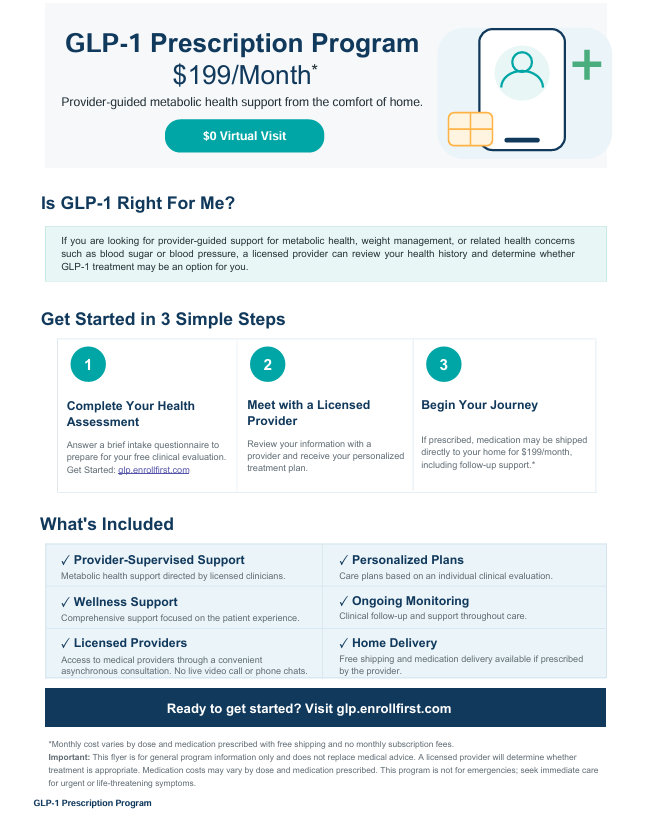
Option C: Provider-Supervised Telehealth GLP-1 Programs ($199/Month). This has quickly become the most popular, transparent, and affordable alternative for consumers without insurance coverage. Through partnerships like Enrollment First's GLP-1 Prescription Program at glp.enrollfirst.com, patients receive comprehensive, provider-guided metabolic health support from the comfort of home starting at $199 per month with $0 virtual visit fees and free home delivery.
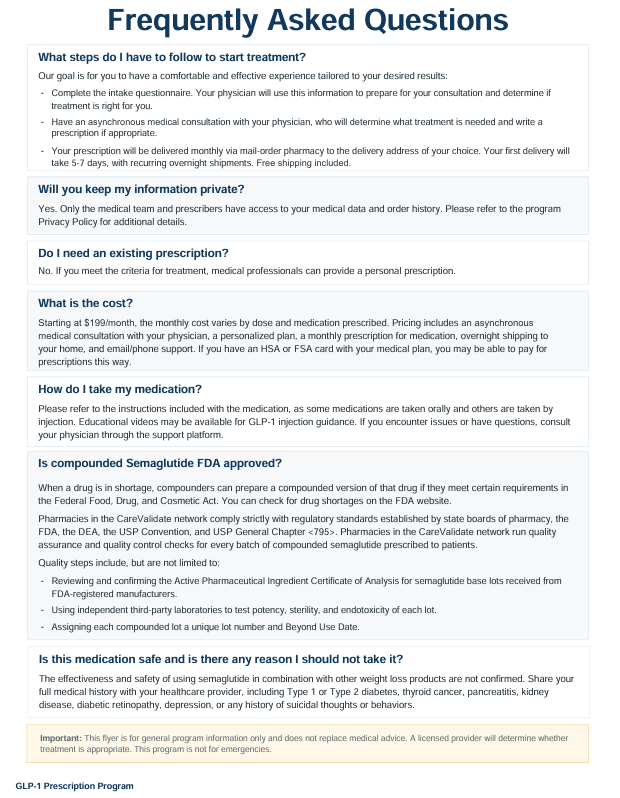
How the $199/Month GLP-1 Telehealth Program works. The program is designed to remove the insurance red tape entirely. Here is the 3-step process: Step 1 — Complete a brief online health intake questionnaire at glp.enrollfirst.com. Step 2 — A licensed medical provider reviews your health history through a convenient asynchronous consultation (no awkward live video calls or scheduled phone slots) and creates a personalized treatment plan if appropriate. Step 3 — If prescribed, your medication is shipped directly to your door with free overnight delivery, with recurring monthly shipments and clinical follow-up support. The $199/month starting price includes the doctor consultation, personalized treatment plan, medication, overnight home delivery, and email/phone clinical support — and if you have an HSA or FSA card, you can often pay with pre-tax dollars.
Quality and safety: Is compounded Semaglutide legitimate? The program utilizes pharmacies in the CareValidate network that comply strictly with standards established by state boards of pharmacy, the FDA, the DEA, the USP Convention, and USP General Chapter <795>. Quality protocols include reviewing and confirming the Active Pharmaceutical Ingredient (API) Certificate of Analysis from FDA-registered manufacturers, third-party laboratory testing for potency, sterility, and endotoxicity on every batch, and unique lot numbering with Beyond Use Dating. As always, you must share your complete medical history with the prescribing clinician — GLP-1s are not suitable for individuals with personal or family history of medullary thyroid cancer, multiple endocrine neoplasia syndrome type 2 (MEN 2), pancreatitis, or active pregnancy.
7. The common GLP-1 medications and which ones insurance actually covers. There are now six GLP-1 (and dual GLP-1/GIP) medications on the U.S. market, and your coverage hinges on which FDA-approved indication is on your chart — not just the brand name. Here is the quick reference: Ozempic (semaglutide) and Mounjaro (tirzepatide) are approved for Type 2 diabetes, so Medicare Part D, most ACA plans, and most private plans cover them with prior authorization. Wegovy (semaglutide) is approved for weight loss and cardiovascular risk reduction — Part D covers it only for the cardiovascular indication, the GLP-1 Bridge offers it for $50/month for weight loss, and most ACA plans exclude it. Zepbound (tirzepatide) and Saxenda (liraglutide) are approved for chronic weight management, so Medicare and most ACA plans generally do not cover them, though some private/employer plans do with prior authorization. Trulicity (dulaglutide) is approved for Type 2 diabetes and cardiovascular risk, so it is covered like Ozempic and Mounjaro. The chart below summarizes it all at a glance.
GLP-1 Coverage at a Glance
| Medication (active ingredient)FDA indication | Medicare Part D | ACA Marketplace | Private / Employer |
|---|---|---|---|
Ozempic (semaglutide) Type 2 diabetes | ✅Covered | ✅Covered | ✅Covered |
Wegovy (semaglutide) Weight loss + CV risk reduction | ⚠️With conditionsBridge: $50/mo through 12/31/2027 | ❌Not covered | ⚠️With conditions |
Mounjaro (tirzepatide) Type 2 diabetes | ✅Covered | ✅Covered | ✅Covered |
Zepbound (tirzepatide) Weight loss + sleep apnea | ❌Not covered | ❌Not covered | ⚠️With conditionsVaries by plan & state |
Trulicity (dulaglutide) Type 2 diabetes + CV risk | ✅Covered | ✅Covered | ✅Covered |
Saxenda (liraglutide) Chronic weight management | ❌Not covered | ❌Not covered | ⚠️With conditionsVaries by plan & state |
Coverage depends on the diagnosis on your chart — not just the drug name. ✅ = typically covered · ⚠ = covered with conditions (prior auth / step therapy) · ❌ = generally not covered
8. The dangerous rise of black-market and counterfeit GLP-1s. I have to say this plainly because I see it every week: please do not buy GLP-1 medications from unlicensed online sellers, social media ads, med-spas that ship unbranded vials, or 'research' websites offering semaglutide at suspiciously low prices. The FDA, Novo Nordisk, and Eli Lilly have all issued warnings about counterfeit pens and vials that contain no active ingredient, the wrong dose, or dangerous contaminants — some have caused serious infections and hospitalizations. Black-market 'compounded' products that are not from a state-licensed 503A or FDA-registered 503B pharmacy are not reviewed for sterility or potency. Injecting an unsterile or mislabeled product is simply not worth the risk to your health. The safe, legal alternatives are: (1) work with your doctor and insurance on a covered indication, (2) use the $50/month Medicare GLP-1 Bridge if eligible, or (3) use a legitimate provider-supervised program like the $199/month telehealth option at glp.enrollfirst.com, which sources from FDA-registered, third-party-tested pharmacies. If a deal looks too cheap to be real, it almost certainly is not real.
Is it illegal to buy or sell GLP-1s on the black market? Yes — and this is important to understand. GLP-1 medications like Ozempic, Wegovy, Mounjaro, Zepbound, and Trulicity are prescription-only drugs regulated by the FDA under the Federal Food, Drug, and Cosmetic Act. Selling or distributing prescription medications without a valid pharmacy license and DEA registration is a federal crime under 21 U.S.C. § 333. The penalties are serious: a first offense under § 333(a) is a misdemeanor punishable by up to 1 year in prison and fines up to $100,000 for an individual (or $200,000 for a corporation). If the violation involves fraud, misrepresentation, or a prior conviction, it escalates to a felony under § 333(b) with up to 3 years in prison — and if the violation results in serious bodily injury or death, the sentence can reach 6 years or even life imprisonment. Fines for subsequent or fraudulent violations can reach $250,000 for individuals and $500,000 for organizations. This applies to anyone — including a friend, coworker, or social media contact — who sells you GLP-1 vials, pens, or 'compounded' product from an unlicensed source. But here is what surprises most people: buying them is illegal too. Purchasing prescription drugs from anyone other than a licensed U.S. pharmacy or licensed healthcare provider is unlawful, and you can face legal consequences as the buyer — including potential criminal misdemeanor charges and civil money penalties from the FDA — not to mention the serious health risks of injecting an unregulated, unsterile, or counterfeit product. On top of federal charges, both buyers and sellers may also face state-level penalties for practicing pharmacy without a license, which can carry additional fines and jail time depending on the state. There is no 'personal use' exception for buying prescription drugs from an unlicensed domestic seller. If a friend or anyone offers to sell you GLP-1 medication outside of a licensed pharmacy or a legitimate provider-supervised program, the legal and safe answer is no — for both of you. The only legal paths are: (1) a prescription filled at a licensed U.S. pharmacy through your insurance, (2) the $50/month Medicare GLP-1 Bridge if eligible, or (3) a legitimate provider-supervised telehealth program like the $199/month option at glp.enrollfirst.com that sources from FDA-registered, third-party-tested pharmacies.
The broker's bottom line. Don't waste weeks fighting pharmacy rejections without knowing the rules. If you have Type 2 diabetes or documented cardiovascular disease, let's look at your ACA or Medicare formulary and help your doctor submit a winning Prior Authorization. But if you are seeking GLP-1 treatment for metabolic health and weight loss alone, avoid the $1,000/month retail cash trap: explore the $199/month provider-guided telehealth program at glp.enrollfirst.com or consult with a licensed broker. As an independent broker (NPN 17808176) licensed in 28 states, I help clients navigate both their comprehensive health coverage and direct metabolic health programs so you get the care you need at a price that actually fits your budget. Call me directly at (407) 815-0820 or book a free consultation below.
Ask a Question About this Article or Suggest an Article to Write
Have a question about what you just read, or an insurance topic you'd like John to write about next? Send it to John and he'll personally reply with expert, no-pressure guidance.
Need help finding GLP-1 coverage or an affordable alternative?
Whether you need to check if your ACA or Medicare plan covers GLP-1s for diabetes / cardiovascular conditions, or you want to start the $199/month provider-guided telehealth program at glp.enrollfirst.com, John Dennis (NPN 17808176) can guide you through every step. Free, independent advice.
Have questions about this topic?
Book a free, no-pressure consultation with John Dennis, independent licensed insurance broker.
Book an appointment