What Is the Difference Between an HMO, EPO, POS, and PPO? (With a Simple Diagram)
These four letters decide whether you need a referral, whether you can see out-of-network doctors, and how much you pay each month. Here is a plain-English breakdown with examples and an easy-to-read comparison diagram.
John Dennis, Theology MA, MBA, Biology BA — AliveInsure.com
Health, Medicare & Life Insurance Broker
When you shop for health insurance — on the Affordable Care Act Marketplace, through an employer, or directly from a carrier — almost every plan you see falls into one of four categories: HMO, EPO, POS, or PPO. These three-letter abbreviations are not marketing fluff. They determine whether you need a primary care doctor, whether you need a referral to see a specialist, whether the plan pays anything when you go out of network, and how much your monthly premium costs. Choosing the wrong type is one of the most common — and most expensive — mistakes people make. Let's break down each one in plain English, with real examples, and then look at a simple diagram that shows the differences and similarities side by side.
1. HMO (Health Maintenance Organization). An HMO is built around a primary care physician (PCP). You must choose a PCP within the network, and that doctor becomes your gateway to the rest of the system. Need to see a cardiologist, a dermatologist, or get an MRI? In most cases your PCP must write a referral first. If you go straight to a specialist without a referral — or visit an out-of-network provider — the HMO generally pays nothing, and you are responsible for the full bill (except in a true emergency). HMOs usually have the lowest monthly premiums of the four types, which makes them attractive to healthy people and budget-conscious families. Real-world example: many Kaiser Permanente plans are classic HMOs — your PCP, your specialists, and your hospital are all inside one coordinated system. The trade-off for the lower price is less flexibility and more paperwork when you need specialized care.
2. EPO (Exclusive Provider Organization). An EPO is the middle ground in one specific way: like an HMO, an EPO only covers in-network providers (out-of-network care is not covered, except in emergencies). But unlike an HMO, an EPO does not require you to choose a primary care doctor or get a referral to see a specialist. That means you can book a dermatologist, an orthopedic specialist, or a gastroenterologist directly, as long as they are in the network. EPOs tend to cost a little more than HMOs but less than PPOs. Real-world example: many Oscar Health and Ambetter plans on the ACA Marketplace are EPOs. They give you the freedom to self-refer to specialists without the cost of a full PPO network — but you must stay in network or pay 100% yourself.
3. POS (Point of Service). A POS plan is essentially a hybrid that combines features of an HMO and a PPO. Like an HMO, you choose a primary care doctor and you need a referral from that PCP to see a specialist. Like a PPO, a POS plan does offer some out-of-network coverage — but only at a lower reimbursement rate, with higher deductibles and copays, and often only after you meet a separate out-of-network deductible. So you have the option to go out of network, but it will cost you more. POS plans sit in the middle on price. Real-world example: some employer-sponsored plans through Cigna or Aetna are POS plans, giving employees in-network HMO-style coordination with a safety valve for out-of-network specialists when truly necessary.
4. PPO (Preferred Provider Organization). A PPO offers the most flexibility — and usually the highest monthly premium. You do not need to choose a primary care doctor, and you do not need a referral to see any specialist. You can also go out of network and still receive partial coverage; the plan simply pays a lower percentage (for example, 60% instead of 80%), and you pay more out of pocket. PPOs are ideal for people who travel frequently, who have specialists they want to keep even if those doctors are not in a narrow network, or who simply want maximum freedom and are willing to pay for it. Real-world example: Blue Cross Blue Shield PPO and UnitedHealthcare Choice Plus PPO are among the most recognized PPO networks nationwide, with enormous doctor and hospital lists and out-of-network benefits in every state.
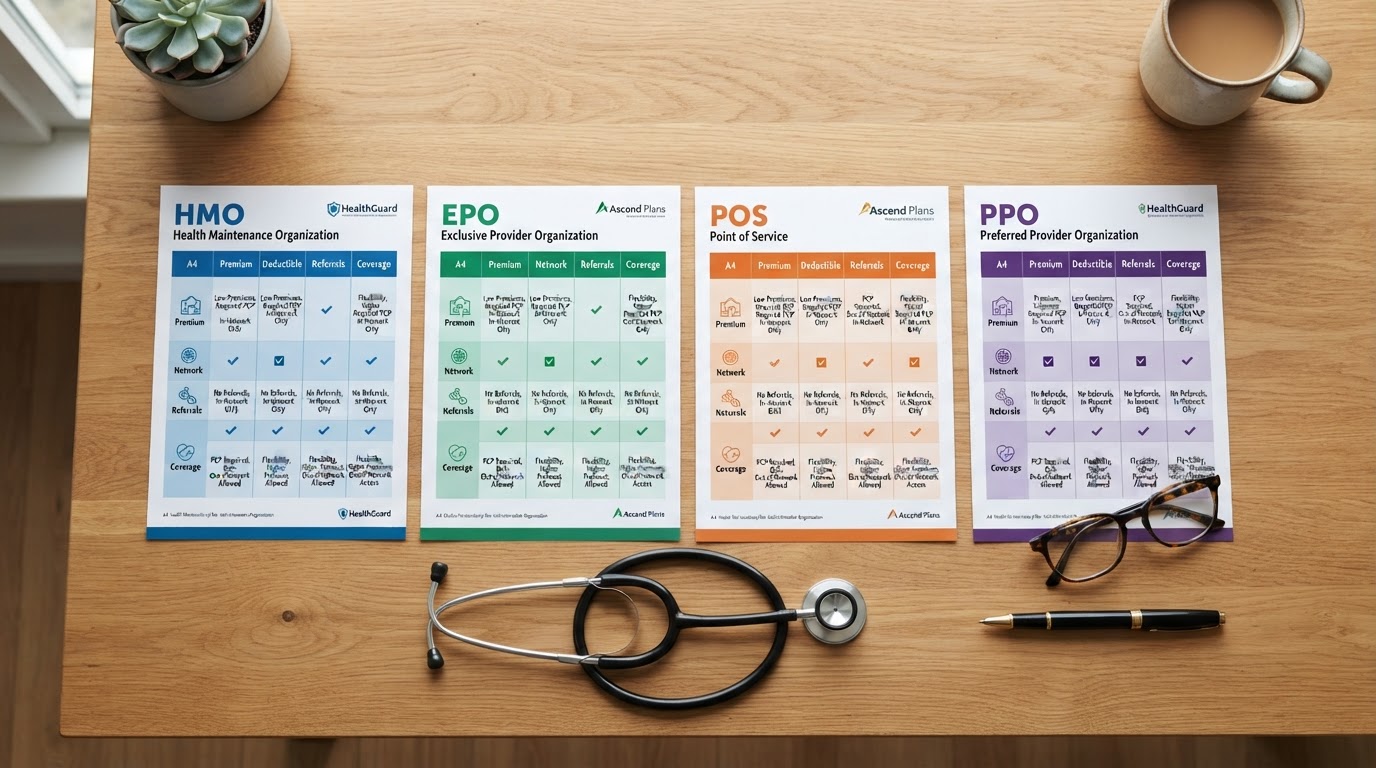
Here is the quick visual summary. The diagram below shows all four plan types side by side so you can compare the key rules at a glance: whether a primary care doctor is required, whether you need a referral to see a specialist, whether the plan covers out-of-network care, and the general trade-off between flexibility and monthly cost.
How do you choose the right type for you? The decision comes down to three honest questions about yourself. First, do you have doctors or specialists you absolutely must keep? If yes, check whether they are in the network before you enroll — and lean toward a PPO if they are out of network. Second, are you comfortable having a primary care doctor coordinate your care and write referrals? If you find that convenient, an HMO or POS can save you real money. If you prefer to book specialists yourself without a gatekeeper, look at an EPO or PPO. Third, what is your tolerance for surprise bills? HMOs and EPOs offer the predictability of 'in network only,' while PPOs give you a financial cushion if you ever end up out of network by accident.
There is one more similarity worth knowing: all four types sold on the ACA Marketplace cover the same ten Essential Health Benefits, including preventive care, prescription drugs, maternity care, mental health, and emergency services. The network type changes how you access care — not what is covered when you do. And no matter which type you pick, the same CMS rule applies: always verify your doctor and hospital are in-network before your appointment, because networks change throughout the year.
If you are comparing plans and the alphabet soup of HMO, EPO, POS, and PPO is making your head spin, you do not have to decode it alone. As an independent licensed insurance broker (NPN 17808176) licensed in 28 states, I can pull the plans available in your zip code, check whether your specific doctors are in-network, and explain the real cost difference in dollars — not just acronyms. Call me directly at (407) 815-0820 or book a free consultation below.
Ask a Question About this Article or Suggest an Article to Write
Have a question about what you just read, or an insurance topic you'd like John to write about next? Send it to John and he'll personally reply with expert, no-pressure guidance.
Not sure which plan type fits your doctors and budget?
I can pull every plan in your zip code, verify your doctors are in-network, and explain the real monthly cost difference in plain dollars. Free, independent advice from a licensed broker.
Have questions about this topic?
Book a free, no-pressure consultation with John Dennis, independent licensed insurance broker.
Book an appointment